What Is an Intrinsically Safe Tablet?
A plain-language guide to ATEX and IECEx certification for tablets in hazardous areas — written for HSE engineers, procurement, and operations teams.
The short answer
An intrinsically safe (IS) tablet is a mobile device certified to operate in explosive atmospheres — environments where flammable gases, vapours, or combustible dust are present. The device is engineered so that its electrical circuits cannot produce enough energy (sparks or heat) to ignite the surrounding atmosphere.
Certification is granted under two frameworks:
- ATEX — the EU directive (2014/34/EU) mandatory within the European Economic Area
- IECEx — the international certification scheme, accepted in most countries worldwide
Are Samsung tablets intrinsically safe? No: see which Samsung, Apple and Google tablets are and are not certified, and the certified alternatives.
Are Samsung tablets intrinsically safe? No: see which Samsung, Apple and Google tablets are and are not certified, and the certified alternatives.
Are Samsung tablets intrinsically safe? No: see which Samsung, Apple and Google tablets are and are not certified, and the certified alternatives.
Are Samsung tablets intrinsically safe? No: see which Samsung, Apple and Google tablets are and are not certified, and the certified alternatives.
Why tablets in hazardous areas?
Tablets fill a gap that phones can't. While intrinsically safe phones handle communication and quick data capture, tablets provide:
- Larger screen — 8–11″ displays for inspection forms, P&IDs, and drawings
- Stylus input — annotation and markup directly on documents
- SCADA/HMI access — dashboard visibility at the process unit
- Full desktop apps — Windows tablets run SAP, Maximo, and legacy inspection software natively
Why can't I use a normal iPad?
Standard tablets contain multiple ignition sources:
- Large battery — tablets have 2–4x the battery capacity of phones, storing significantly more energy
- Charging port — making/breaking electrical connections creates sparks
- Display backlight — larger screens draw more power, increasing surface temperatures
- Processor under load — running SCADA or CAD applications can push thermal limits
In a Zone 1 environment, any of these could trigger an ignition event. IS certification ensures that energy levels across all circuits stay below the minimum ignition energy of the target gas group.
Zone classification: Zone 0, 1, and 2
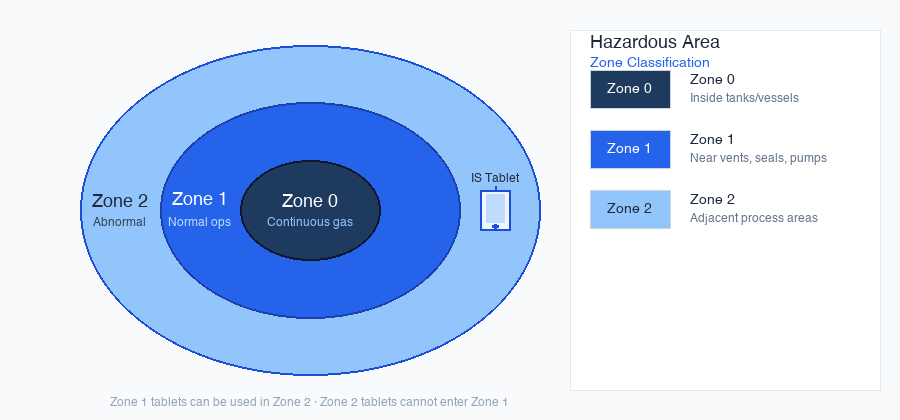
| Zone | Gas/vapour frequency | Typical locations |
|---|---|---|
| Zone 0 | Continuously or for long periods | Inside tanks, vessels, pipelines |
| Zone 1 | Likely during normal operations | Near vents, flanges, pump seals, loading areas |
| Zone 2 | Not likely, only under abnormal conditions | Areas adjacent to Zone 1, well-ventilated process areas |
A Zone 1 certified tablet can also be used in Zone 2. A Zone 2 tablet cannot be used in Zone 1. Most IS tablets target Zone 1 certification.
ATEX vs IECEx
| Aspect | ATEX | IECEx |
|---|---|---|
| Scope | European Economic Area | International (50+ countries) |
| Legal basis | EU Directive 2014/34/EU | IEC standards scheme |
| Mandatory? | Yes, within the EEA | Accepted, not always mandatory |
| Marking | CE + Ex hexagon | IECEx certificate number |
Gas groups: IIA, IIB, IIC
| Gas group | Example gases | Ignition difficulty |
|---|---|---|
| IIA | Propane, methane, diesel | Hardest to ignite |
| IIB | Ethylene, hydrogen sulphide | Medium |
| IIC | Hydrogen, acetylene | Easiest to ignite |
A device certified for IIC covers all gas groups. Most modern IS tablets target IIC.
Android vs Windows
Unlike the phone market (where Android dominates), the tablet market offers a real choice between operating systems:
| Factor | Android | Windows |
|---|---|---|
| Typical use | Inspections, checklists, photos | SAP, SCADA, CAD, legacy apps |
| Weight | 570–750 g | 850–1400 g |
| Battery life | 8–12 hours | 4–8 hours |
| App ecosystem | Google Play (broad) | Desktop apps (specialised) |
| Zone 1 models compared on this site | 3 (Tab-Ex 03 DZ1, Tab-Ex Pro DZ1, IS930.1) | 2 (Aegex 10 IS, Bartec Agile X IS) |
How to choose the right IS tablet
- Zone classification — what zones exist on your site?
- Gas group — which gases are present? IIC covers all.
- Regional certification — ATEX, IECEx, or both?
- Operating system — do you need Windows apps or is Android sufficient?
- Screen size — 8″ for portability or 10″+ for forms and drawings?
- Stylus support — do workers need to annotate documents in the field?
- Integration — MDM, ERP, inspection software compatibility?
Frequently asked questions
Can I use a normal iPad in a hazardous area?
No. Standard iPads are not certified for explosive atmospheres. You need an Ex-certified tablet, or an iPad in a certified Ex enclosure or conversion. Using an uncertified device in a classified area violates ATEX/DSEAR regulations and risks explosion.
What is the difference between Zone 1 and Zone 2?
Zone 1 means an explosive gas atmosphere is likely during normal operations. Zone 2 means it only occurs under abnormal conditions. Zone 1 tablets can also be used in Zone 2, but not vice versa.
Is there a Zone 1 iPad case?
Yes. For full-size iPads, the Xshielder iPad Pro 11 case (Ex db IIC T6) is ATEX Zone 1/21 certified. It has no IECEx certificate. For the iPad mini, Xciel ships ATEX/IECEx Zone 1 flameproof enclosures for the iPad mini 4–7 (XCZ1 series, factory-fitted). Atexxo has announced a Zone 1/21 converted iPad 11″ (Ex db IIC T4). Zone 2 iPad solutions from Atexxo (converted iPads) and Xciel (C1D2/Zone 2 cases) ship today.
How much does an intrinsically safe tablet cost?
Prices are on request and are not published on this site. The cost depends on the model, configuration, accessories and order volume. For total cost of ownership, also budget for docking stations, screen protectors, and MDM licensing (see ATEX tablet costs). Ask for a price for the models you are considering.